The Mic Hears Everything
Inside my first audiobook recording - and why Jewish authors must tell their stories in their own voice.

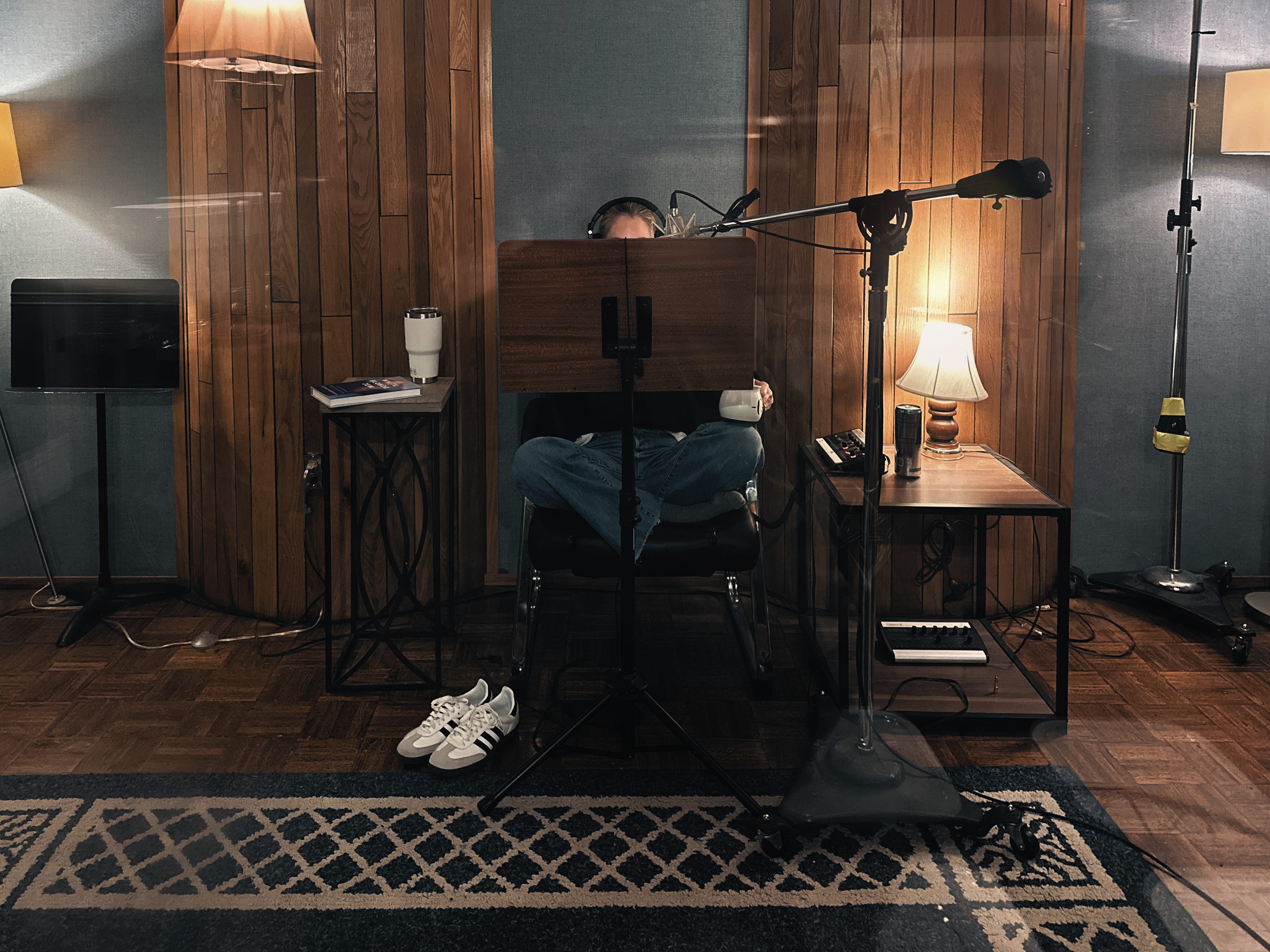
By day three, I understood why audiobook recording is described as a vocal marathon.
It is not reading. It is physical endurance.
The microphone hears everything: your breath catching, your stomach growling, a bracelet shifting against your wrist, the sound of uncrossing your legs after sitting still too long. Nothing stays hidden.
I started eating enormous breakfasts before sessions just to keep my body quiet. No jewelry. Hair pulled back. Throat Coat tea constantly within reach. You become oddly athletic about it. The body either cooperates with the work or interrupts it.


And then there’s the most unexpected part: hearing your producer’s voice in your ear while you read some of the most personal moments of your life out loud. A human you’ve only just met, suddenly guiding you through emotional territory you once wrote alone in silence.
I have never recorded an audiobook before. My first book never required this. The photographs carried the emotional weight. They were the language.
But this week taught me something entirely different: voice changes everything.
What I learned (that every author should know before stepping into the booth):
Your body becomes part of the storytelling -
Audiobook recording exposes how inseparable the body is from storytelling. Writing is cerebral. Recording is physiological. If you are anxious, dehydrated, emotional, excited, exhausted - the mic catches it immediately. There is no separation between the work and the person delivering it.
By the end of the week, I understood why so many authors struggle emotionally inside the booth. Reading vulnerable passages aloud collapses distance. You are no longer analyzing your story. You are back inside it.
Preparation becomes ritual: food, hydration, silence, sleep, even clothing. I lived in cozy tennis shoes and soft, quiet fabrics all week because anything stiff or noisy became part of the recording. You stop moving through the day casually. Everything starts revolving around protecting the voice and sustaining the nervous system long enough to stay emotionally present.
You hear your writing differently out loud -
The moment words leave the page and enter the air, they reveal themselves differently. Sentences you thought were clean suddenly feel heavy in the mouth. Others come alive with a precision you did not fully expect while writing them.
I have a dry sense of humor that reads clearly on the page, but speaking it introduced another level of awareness around tone. A line that feels clever internally can sound cold or sharp once spoken aloud.
Voice removes ambiguity. You stop editing for the eye and start editing for the nervous system.
You stop asking: “Does this work on the page?” And start asking:“Does this hold in the air?”
That shift changes everything.


Presence over performance -
There were moments I could hear genuine emotion rising in my throat while recording. I never stopped to smooth those moments over. Listeners do not connect to perfection. They connect to presence. And presence is harder than performance.
The mic exposes performance almost instantly. You can hear when someone is over-narrating, over-polishing, trying too hard to sound authoritative or composed. The strongest takes came when I stopped trying to sound like a narrator and simply returned to the truth of the sentence.
The closer you stay to the state you wrote from, the more dimensional the reading becomes.
That required more courage than I expected.
There were lines where I felt myself instinctively softening - not because the writing was wrong, but because taking up space can still feel uncomfortable. For many people. Sometimes for me, especially after moments where visibility has carried real consequences, including death threats.
The work was not to make the sentences safer. My work was to stay visible inside them.
Why Jewish authors should read their own stories -
This book was not a casual one for me to record. I wrote it for many reasons, including my response to the boycotts against Jewish authors and the broader attempt to silence Jewish creative work. My response is the same as it has always been:
I will continue to publish.
I will continue to create.
There is a heightened reality to being a Jewish author right now that cannot be separated from the work itself. According to the ADL, antisemitic incidents in the U.S. now average more than 17 per day, with a 39% year-over-year increase in violence, including weapons and fatal attacks. I do not move through public life casually anymore. None of us really do.
Which makes voice matter even more.
For years, media psychology researchers have studied how voice changes human perception. Hearing someone speak creates a sense of relational closeness that text alone rarely achieves.
A written book can communicate an idea. A voice allows someone to encounter the person carrying it.
And that matters deeply in a moment where Jews are increasingly flattened into abstractions - headlines, politics, projections, scapegoats - rather than experienced as human beings with humor, grief, warmth, contradiction, memory, fear, intelligence, family, and interior lives.
Voice restores dimension. When someone spends hours listening to another human being breathe, pause, laugh softly at their own line, struggle through a sentence, gather themselves, emotionally continue - something shifts.
The listener is no longer consuming a position. They are sitting with a person and that is not a small distinction. It is human. It is powerful.


What surprised me most
I thought I was going into a studio to simply record a manuscript.
Instead, I spent the week learning how much storytelling lives in the body. How silence becomes part of a narrative. How even egg white and spinach tacos can determine whether your stomach interrupts a sentence mid-thought. How exhausting it is to remain emotionally honest for hours at a time. How imperfection is sometimes the most generous thing you can offer a listener.
It was far harder than I expected. And far more meaningful.
Every day, I left deeply grateful for the experience.
You do not just read your book aloud. You meet it again - in real time, in your own voice, with nowhere to hide.
I wrote White. Blonde. Jew. for you.
And I dedicated it to the lights that were taken from us too soon.